

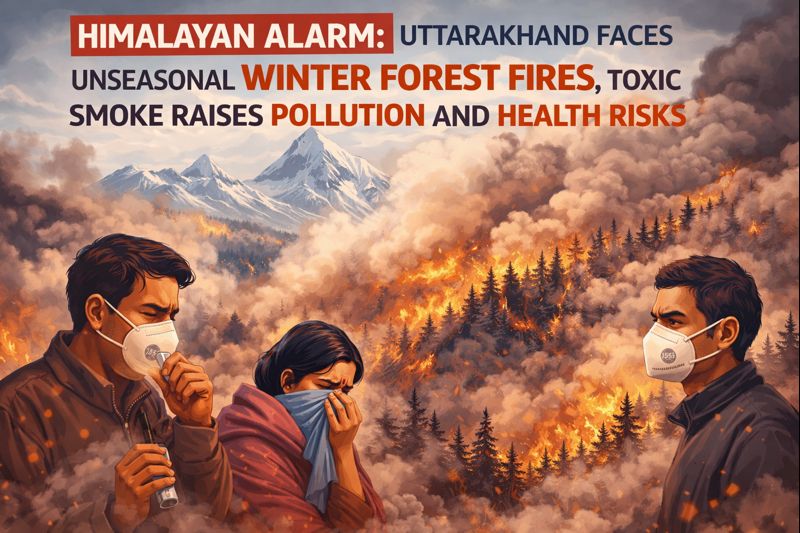
Early Forest Fires Signal a Growing Environmental Crisis Uttarakhand is witnessing an unusual and alarming rise in forest fires during winter, a period traditionally considered low-risk. Experts warn that reduced rainfall and snowfall, combined with warmer-than-normal temperatures, have turned the Himalayan forests highly vulnerable to fire. This early outbreak has raised serious concerns about air
Early Forest Fires Signal a Growing Environmental Crisis
Uttarakhand is witnessing an unusual and alarming rise in forest fires during winter, a period traditionally considered low-risk. Experts warn that reduced rainfall and snowfall, combined with warmer-than-normal temperatures, have turned the Himalayan forests highly vulnerable to fire.
This early outbreak has raised serious concerns about air pollution, public health, biodiversity loss, and climate change, not only for mountain communities but also for nearby cities.
Global Lessons Highlight Local Danger
Around the world, wildfires in the United States, Australia, and Canada have shown that forest fires are no longer limited to ecological damage. They have become a major environmental and public health emergency, affecting air quality, water sources, soil fertility, and long-term human health.
Uttarakhand now appears to be following the same dangerous path.
Why Are Forest Fires Occurring in Winter?
Low Rainfall and Snowfall Leave Forests Dry
According to Professor S.P. Sati, geologist at Veer Chandra Singh Garhwali Uttarakhand University, the primary cause is a prolonged dry spell. Many mountain peaks that are usually snow-covered in winter remain bare this year.
Dry leaves, grass, and shrubs have accumulated across forest floors, creating highly flammable conditions. As a result, forests that typically burn between March and June are now catching fire as early as January.
Longer Fire Season, Greater Damage
Experts fear that early winter fires may extend the forest fire season, increasing the scale of destruction and making fire control more difficult in the months ahead.
Toxic Smoke Worsens Air Pollution
Cities Record Dangerous AQI Levels
Smoke from burning forests has significantly worsened air quality across Uttarakhand. Cities such as Dehradun, Rishikesh, and Haldwani have reported Air Quality Index (AQI) levels above 300, which fall into the hazardous category.
Severe Health Risks for Vulnerable Groups
Doctors warn that children, elderly people, and patients with asthma or heart disease are especially at risk. Long-term exposure to fine particles and toxic gases increases the chances of bronchitis, asthma attacks, lung infections, and cardiovascular problems.
Forest Fires Contribute Up to 20% of Pollution
Official Data Raises Serious Concerns
A study by the Uttarakhand Environment Protection Board (PCB) reveals that forest fires contribute 15 to 20 percent of the state’s total environmental pollution. This places fires alongside vehicle emissions, construction dust, and industrial pollution as a major pollution source.
PCB Member Secretary Parag Madhukar Dhakate explained that forest fires release carbon dioxide, methane, carbon monoxide, and PM2.5 particles, all of which are harmful to human health and accelerate global warming.
Large Forest Areas Remain Fire-Prone
High-Risk Zones Identified
According to the India State of Forest Report, over 36 percent of Uttarakhand’s forest area is prone to frequent fires, while nearly 7.85 percent is classified as highly sensitive.
With fires starting before the usual season, these vulnerable zones face heightened and prolonged risk.
Impact on Biodiversity and Himalayan Glaciers
Wildlife and Ecosystems Under Threat
Forest fires destroy natural habitats, threatening wildlife and plant diversity. Entire ecosystems are disrupted, leading to long-term ecological imbalance.
Black Carbon Speeds Up Glacier Melting
Professor Sati also highlighted the danger of black carbon particles, which travel long distances and settle on Himalayan glaciers. These particles absorb sunlight, causing faster glacier melt, which may lead to water shortages, floods, and climate-related disasters in the future.
Forest Fires Are an Attack on Air, Water, and Climate
Experts agree that forest fires in Uttarakhand are no longer just a forestry issue. They represent a direct threat to air quality, water security, public health, and climate stability.
Without urgent action, the state could face worsening pollution and irreversible environmental damage.
Prevention Requires Community and Government Action
Key Measures to Reduce Fire Risk
-
Early warning systems and real-time monitoring
-
Awareness campaigns in forest villages
-
Increased patrols during dry months
-
Use of sensors and satellite tracking
-
Active involvement of local communities
Protecting forests requires joint responsibility between government agencies and residents.
A Warning for the Himalayas
The rise of winter forest fires in Uttarakhand is a clear warning sign. These fires threaten biodiversity, public health, and the fragile Himalayan ecosystem.
Saving Uttarakhand’s forests is not just about preserving trees—it is about protecting lives, climate balance, and the future of the Himalayas.












Leave a Comment
Your email address will not be published. Required fields are marked with *